- 東京都健康長寿医療センター(研究所)
- English
- Research Team
- Research Team for Aging Science
- Molecular and Cellular Metabolism
Molecular and Cellular Metabolism
Members
| Theme leader | Kenichi Takayama, M.D., Ph.D.
|
| Researcher | Masumi Iketani, Ph.D. |
Keywords
Epigenome, Geriatric Diseases, Energy Metabolism, Bone Metabolism, Neural Differentiation, Aging, Dementia, Sex Hormone Receptors, DNA Methylation, Histone Modifications, Chromatin Remodeling, Transcription Factors, Metabolic Enzymes, RNA-Binding Proteins, Liquid-Liquid Phase Separation, Hydrogen, Mitochondria, Inflammation, Autophagy, Ubiquitin
Major Research Titles
- Epigenomic Regulation and Intracellular Metabolic Pathways Driving the Onset of Age-Related Diseases
- Mechanisms Governing RNA-Protein Metabolic Dynamics
- RNA‑Binding Protein Dysregulation as a Driver of Age‑Related Diseases
Profile
The epigenome is a fundamental regulatory system that is dynamically shaped by our living environment, external stimuli, and various forms of stress. It not only establishes individual biological traits but also influences susceptibility to disease. Our
research group focuses on the epigenome to uncover the mechanisms that regulate vital biological processes and the onset of geriatric diseases, ultimately aiming to develop new strategies for prevention and treatment. Genetic information is encoded in
the genome, which consists of DNA located in the nucleus of each cell. Although the DNA sequence inherited from our parents is identical across tissues including brain, bone, or skin, the epigenomic landscape surrounding this DNA differs markedly among
cell types. Moreover, it is now evident that the epigenome undergoes substantial changes in response to lifestyle factors, aging, and the development of diseases such as cancer.
Epigenomic regulation is deeply involved in a wide range of biological phenomena, such as aging, cancer-related abnormalities, cellular metabolism, and energy metabolism. Our team investigates the mechanisms underlying geriatric diseases such as dementia
and osteoporosis, as well as the processes driving age-related changes in the brain and bone (Figure 1).
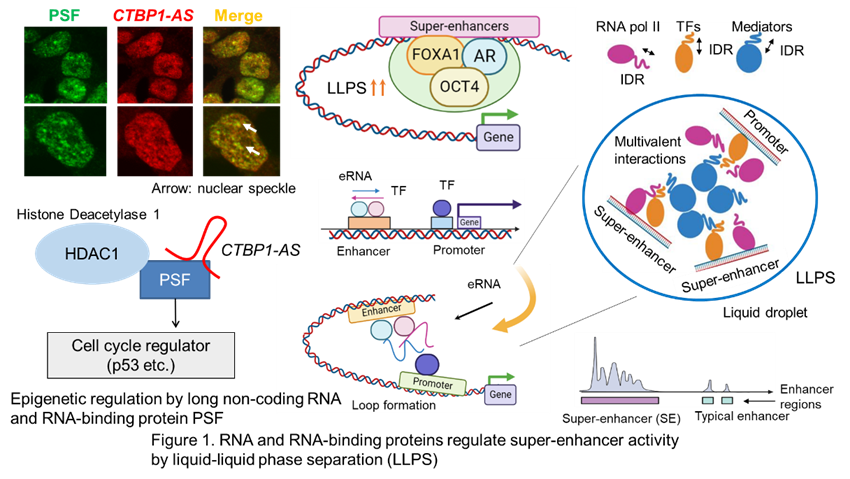
In recent years, it has become clear that abnormalities in RNA‑binding proteins can disrupt liquid-liquid phase separation-mediated granule formation, leading to neurodegenerative diseases such as ALS. This discovery has drawn significant attention, as
it suggests a new avenue for understanding previously unexplained intractable diseases. Among these proteins, we have focused our research on PSF, an RNA‑binding protein.
PSF plays an essential role in brain development. By identifying the RNAs bound by PSF and analyzing their functions, we found that PSF is deeply involved in neuronal function and cognitive processes. In the mouse brain, PSF is highly expressed particularly
in neurons, and its age‑dependent decline was also observed. We further found that PSF expression in the brain is influenced by sex hormones. Moreover, analysis of DNA methylation--an epigenomic marker--revealed an age‑related increase in methylation
at the PSF locus (Figure 2). These results indicate that epigenomic alterations may be a critical regulatory mechanism.
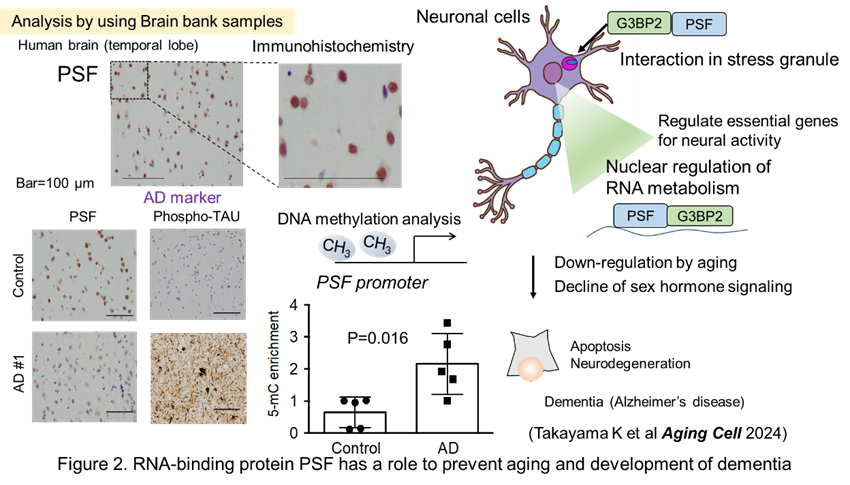
In brain samples from patients with dementia, these epigenomic changes were more pronounced compared with samples from individuals without dementia, and PSF levels were markedly reduced. Taken together, our findings suggest that PSF plays an important role not only in aging but also in the progression of dementia. Taken together, by elucidating these mechanisms, we aim to contribute to the development of approaches that promote resilience against disease and extend healthy lifespan.
References
- Takayama K. The biological and clinical advances of androgen receptor function in age-related diseases and cancer. Endocr J. 2017,64(10), 933-946.
- Takayama K. Mechanistic Roles of Androgen and Estrogen in Aging and Age-Related Diseases J. Ageing Longev. 2026, 6(1), 19
- Takayama K, Sato T, Honma T, Yoshida M, Inoue S. Inhibition of PSF Activity Overcomes Resistance to Treatment in Cancers Harboring Mutant p53. Mol Cancer Ther. 24, 370-383, 2025. (IF: 5.5)
- Takayama K, Suzuki T, Sato K, Saito Y, Inoue S. Cooperative nuclear action of RNA-binding proteins PSF and G3BP2 to sustain neuronal cell viability is decreased in aging and dementia. Aging Cell. 23, e14316, 2024.
- Takayama K, Matsuoka S, Adachi S, Honma T, Yoshida M, Doi T, Shin-Ya K, Yoshida M, Osada H, Inoue S. Identification of small-molecule inhibitors against the interaction of RNA-binding protein PSF and its target RNA for cancer treatment. PNAS Nexus. 2, pgad203, 2023.
- Takayama K, Kosaka T, Suzuki T, Hongo H, Oya M, Fujimura T, Suzuki Y, Inoue S. Subtype-specific collaborative transcription factor networks are promoted by OCT4 in the progression of prostate cancer. Nat Commun. 12, 3766, 2021.
- Takayama K, Honma T, Suzuki T, Kondoh Y, Osada H, Suzuki Y, Yoshida M, Inoue S. Targeting Epigenetic and Posttranscriptional Gene Regulation by PSF Impairs Hormone Therapy-Refractory Cancer Growth. Cancer Res. 81, 3495-3508, 2021.
- Takayama K, Fujimura T, Suzuki Y, Inoue S. Identification of long non-coding RNAs in advanced prostate cancer associated with androgen receptor splicing factors. Commun Biol. 3, 393, 2020.
- Takayama K, Suzuki Y, Yamamoto S, Obinata D, Takahashi S, Inoue S. Integrative Genomic Analysis of OCT1 Reveals Coordinated Regulation of Androgen Receptor in Advanced Prostate Cancer. Endocrinology. 160, 463-472, 2019.
- Takayama K, Fujiwara K, Inoue S. Amyloid precursor protein, an androgen-regulated gene, is targeted by RNA-binding protein PSF/SFPQ in neuronal cells. Genes Cells. 24, 719-730, 2019.
- Takayama K, Suzuki T, Fujimura T, Takahashi S, Inoue S. COBLL1 modulates cell morphology and facilitates androgen receptor genomic binding in advanced prostate cancer. Proc Natl Acad Sci U S A. 115, 4975-4980, 2018.
- Takayama K, Suzuki T, Tanaka T, Fujimura T, Takahashi S, Urano T, Ikeda K, Inoue S. TRIM25 enhances cell growth and cell survival by modulating p53 signals via interaction with G3BP2 in prostate cancer. Oncogene. 37, 2165-2180, 2018.
- Takayama K, Suzuki T, Fujimura T, Yamada Y, Takahashi S, Homma Y, Suzuki Y, Inoue S. Dysregulation of spliceosome gene expression in advanced prostate cancer by RNA-binding protein PSF. Proc Natl Acad Sci U S A. 114, 10461-10466, 2017.
- Takayama K, Misawa A, Suzuki T, Takagi K, Hayashizaki Y, Fujimura T, Homma Y, Takahashi S, Urano T, Inoue S. TET2 repression by androgen hormone regulates global hydroxymethylation status and prostate cancer progression. Nat Commun 6, 8219, 2015.
- Takayama K, Suzuki T, Tsutsumi S, Fujimura T, Takahashi S, Homma Y, Urano T, Aburatani H, Inoue S. Integrative analysis of FOXP1 function reveals a tumor suppressive effect in prostate cancer. Mol Endocrinol 28, 2012-2024, 2014.
- Takayama K, Suzuki T, Fujimura T, Urano T, Takahashi S, Homma Y, Inoue S. CtBP2 modulates the androgen receptor to promote prostate cancer progression. Cancer Res 74, 6542-6553, 2014.
- Takayama K, Horie-Inoue K, Katayama S, Suzuki T, Tsutsumi S, Ikeda K, Urano T, Fujimura T, Takagi K, Takahashi S, Homma Y, Ouchi Y, Aburatani H, Hayashizaki Y, Inoue S. Androgen-responsive long noncoding RNA CTBP1-AS promotes prostate cancer. EMBO J 32, 1665-1680, 2013.
- Sato K, Takayama K, Saito Y, Inoue S. ERRα and ERRγ coordinate expression of genes associated with Alzheimer's disease, inhibiting DKK1 to suppress tau phosphorylation. Proc Natl Acad Sci U S A. 121, e2406854121, 2024
- Misawa A, Takayama K, Urano T, Inoue S. Androgen-induced lncRNA SOCS2-AS1 promotes cell growth and inhibits apoptosis in prostate cancer cells. J Biol Chem 291, 17861-1780, 2016.
- Iketani M, Hatomi M, Fujita Y, Watanabe N, Ito M, Kawaguchi H, Ohsawa I. Inhalation of hydrogen gas mitigates sevoflurane-induced neuronal apoptosis in the neonatal cortex and is associated with changes in protein phosphorylation. J Neurochem Sep;168(9):2775-2790, 2024.
- Iketani M, Sakane I, Fujita Y, Ito M, Ohsawa I. H2-induced transient upregulation of phospholipids with suppression of energy metabolism. Med Gas Res, 13, 3, 133-141, 2023.
- Iketani M, Sekimoto K, Igarashi T, Takahashi M, Komatsu M, Sakane I, Takahashi H, Kawaguchi H, Ohtani-Kaneko R, Ohsawa I. Administration of hydrogen-rich water prevents vascular aging of the aorta in LDL receptor-deficient mice. Sci Rep, 8, 16822, 2018.
- Iketani M, Ohshiro J, Urushibara T, Takahashi M, Arai T, Kawaguchi H, Ohsawa I. Preadministration of hydrogen-rich water protects against lipopolysaccharide-induced sepsis and attenuates liver injury. Shock, 48(1), 85-93, 2017.
- Iketani M, Yokoyama T, Kurihara Y, Strittmatter S, Goshima Y, Kawahara N, Takei K. Axonal branching in lateral olfactory tract is promoted by Nogo Signaling. Sci Rep, 6, 39586, 2016.
- Iketani M, Iizuka A, Sengoku K, Kurihara Y, Nakamura F, Sasaki Y, Sato Y, Yamane M, Matsushita M, Nairn AC, Takamatsu K, Goshima Y, Takei K. Regulation of neurite outgrowth mediated by localized phosphorylation of protein translational factor eEF2 in growth cones. Dev Neurobiol, 73, 3, 230-246, 2013.
- Sato Y*, Iketani M*, Kurihara Y, Yamaguchi M, Yamashita N, Nakamura F, Arie Y, Kawasaki T, Hirata T, Abe T, Kiyonari H, Strittnatter SM., Goshima Y, Takei K. Cartilage acidic protein-1B/LOTUS, an endogenous Nogo receptor antagonist for axon tract formation. Science, 333, 769-773, 2011. *equal contribution
- Iketani M, Imaizumi C, Nakamura F, Jeromin A, Mikoshiba K, Goshima Y, Takei K. Regulation of neurite outgrowth mediated by neuronal calcium sensor-1 and inositol 1,4,5-trisphosphate receptor in nerve growth cones. Neuroscience, 161, 743-752, 2009.
- Arie Y*, Iketani M*, Takamatsu K, Mikoshiba K, Goshima Y, Takei K. Developmental changes in the regulation of calcium-dependent neurite outgrowth. Biochem Biophys Res Commun, 379, 11-15, 2009. *equal contribution