- 東京都健康長寿医療センター(研究所)
- English
- Research Team
- Research Team for Social Participation and Healthy Aging
- Healthy Aging Research
Healthy Aging Research
Members
| Theme Leader | Hiroshi Murayama, R.N., P.H.N., M.P.H., Ph.D. |
| Researcher | Kumiko Nonaka, Ph.D., Yu Nofuji, Ph.D., Yuri Yokoyama, R.D., Ph.D., Takayuki Ueno, R.N., Ph.D. |
| Associate Researcher | Hidenori Amano, M.H.S. |
| Adjunct Researcher | Takumi Abe, Donghyun Kim, Takumi Suda, Yuka Nakamura, Misaki Hirai |
| Adjunct Staff | Yumi Arai, Emiko Nishimura |
| Graduate Students | Yu Imai |
Keywords
Healthy aging, Frailty prevention, Health promotion, Social participation, Employment, Social environment, Health disparity, Health indifference, Epidemiological study, Community intervention
Major Research Titles
Healthy aging is defined as living an independent life while maintaining physical, mental, and social functions. We aim to generate evidence for the establishment of a social system that promotes healthy aging, particularly primary prevention of frailty and dementia.
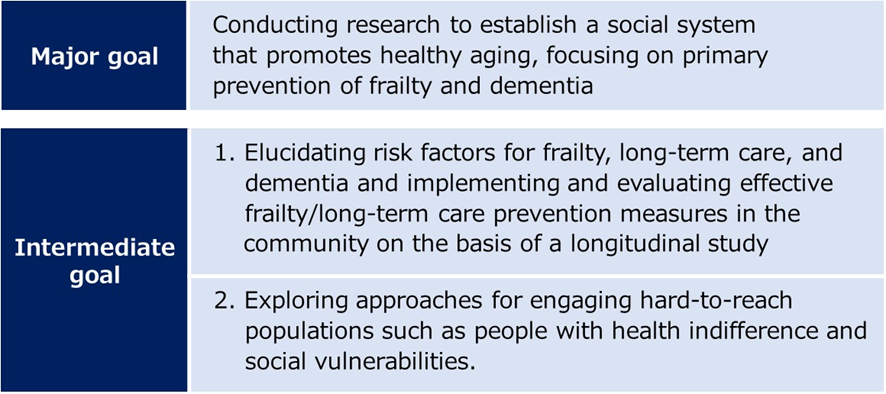
To achieve these goals, we established three pillars of research:
- Basic research: Epidemiological research for long-term care and frailty prevention
- Applied research: Verification of methods for long-term care and frailty prevention
- Challenging research: Investigation of approaches toward difficult-to-reach populations
Profile
1.Basic research: Epidemiological research for long-term care and frailty prevention
We manage several longitudinal cohorts of older adults. Data from the cohort studies are used to conduct epidemiological research on the three pillars of frailty prevention: physical activity, nutrition, and social participation. We also examine individual and environmental factors that promote or inhibit the implementation of strategies that target the three pillars. By collaborating with the local governments, we can approach many regions with different characteristics. This will enable us to disseminate knowledge and implement strategies in diverse regions.
2. Applied research: Verification of methods for long-term care and frailty prevention
We are engaged in the development and implementation of social systems for frailty prevention through community building. The aim of this research theme is to create new opportunities for the employment of older adults. To apply the knowledge accumulated from the studies focused on the three pillars of frailty prevention, we conduct research in both community and workplace.
3. Challenging research: Investigation of approaches toward difficult-to-reach populations
This research theme targets difficult-to-reach populations identified in previous research and practice activities. To achieve healthy aging, we conduct research to develop approaches for promoting changes in awareness and behavior among socially isolated people and health-indifferent populations.
Research Fields
We have conducted epidemiological studies (cohort studies) and field surveys in various parts of Japan, in collaboration with local municipalities.
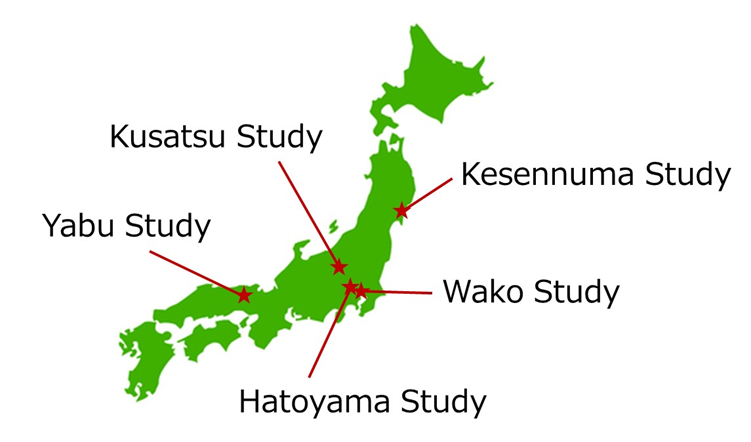
Kusatsu Study (Kusatsu Town, Gunma)
In 2001, we established a collaborative research agreement with the town of Kusatsu and began to collect data through yearly health checkups for residents 65 years and older (the Kusatsu Longitudinal Study). Moreover, we conducted surveys for individuals who did not receive the health checkups once every three years to understand the health status of all older adults in the town. We also collected data regarding outcomes (i.e., death, transfer), need for long-term care certification, and medical/long-term care expenses and combined this information with data from the health checkups and overall surveys. These strategies have enabled an extensive longitudinal analysis. Our study, spanning nearly 20 years, is among the longest studies performed exclusively among older adults in the country.
Representative article
Shinkai S, Yoshida H, Taniguchi Y, Murayama H, Nishi M, Amano H, Nofuji Y, Seino S, Fujiwara Y. Public health approach to preventing frailty in the community and its effect on healthy aging in Japan. Geriatr Gerontol Int 2016; Suppl 1:87-97.
List of research papers from the Kusatsu Study(330.6 KB)
Hatoyama Study (Hatoyama Town, Saitama)
Since the beginning of 2001, we have been conducting social activity surveys and intervention research regarding the training of community welfare volunteers. In 2010, we signed a collaborative research agreement with the town of Hatoyama and began a cohort study of a stratified random sample of residents between 65 and 84 years of age (the Hatoyama Cohort Study). From 2010 to 2018, we conducted health checkups, home visit health checkups, self-administered questionnaire surveys, and multifactorial intervention for preventing frailty. In addition to the cohort study, we conducted questionnaire surveys for all residents aged 65 and over in the town (approximately 5,000 people) in 2018, 2020, and 2023. We also collected data on outcomes (i.e., death, transfer), need for long-term care certification, and medical/long-term care expenses; evaluated measures for the prevention of long-term care; and conducted epidemiological studies to identify risk factors regarding frailty and the need for long-term care.
Representative article (Profile of the Hatoyama Cohort Study)
Murayama H, Nishi M, Shimizu Y, Kim MJ, Yoshida H, Amano H, Fujiwara Y, Shinkai S. The Hatoyama Cohort Study: Design and profile of participants at baseline. J Epidemiol 2012; 22(6): 551-558.
List of research papers from the Hatoyama Study(280.1 KB)
Yabu Study (Yabu City, Hyogo)
Under a cooperative agreement with Yabu City, we have been conducting mailed questionnaire surveys for all residents in Yabu City aged 65 and over every five years since 2012, linking these data with data on outcomes (i.e., death, transfer), need for long-term care certification, and medical/long-term care expenses. Since 2014, we have been conducting a practical study aimed at creating a community for frailty prevention and evaluating its effectiveness by using the longitudinal data we have constructed.
Representative article (Profile of the Yabu Cohort Study)
Murayama H, Nofuji Y, Matsuo E, Nishi M, Taniguchi Y, Fujiwara Y, Shinkai S. The Yabu Cohort Study: Design and profile of participants at baseline. J Epidemiol 2014; 24(6): 519-525.
List of research papers from the Yabu Study(168.7 KB)
Wako Study (Wako City, Saitama)
Under a comprehensive collaboration agreement with Wako City, the Wako Cohort Study was started in 2023, targeting community-dwelling adults aged ≥40 years in Wako City, Saitama Prefecture, Japan. The Wako Cohort Study consists of two surveys: a mail-in survey for persons aged ≥40 years and a face-to-face assessment (on-site survey) for those aged ≥65 years. In the mailed-in survey, approximately 2,700 people aged 40-64 years and 7,100 people aged 65 years and over participated, and, in the on-site survey, approximately 1,000 people aged 65 years and over participated. In the future, follow-up surveys will be conducted using mortality and long-term care insurance information to examine factors that contribute to the achievement of healthy aging.
Representative article (Profile of the Wako Cohort Study)
Yokoyama Y, Nofuji Y, Abe T, Nonaka K, Ozone Y, Nakamura Y, Chiaki S, Suda T, Saito N, Takase M, Amano H, Ogawa S, Suzuki H, Murayama H. The Wako Cohort Study: Design and profile of participants at baseline. J Epidemiol. (in press)
List of research papers from the Wako Study (under construction)
Kesennuma Study (Kesennuma City, Miyagi)
In November 2018, we established a comprehensive collaboration agreement with Kesennuma City and have been working together on community development for health and longevity. In 2019, our research team conducted a community diagnosis through a self-administered questionnaire survey of 10,000 older adults living in Kesennuma City (the Kesennuma Cohort Study). On the basis of the results of this survey, we will work with the local government and community residents to increase the places older adults regularly visit to improve their functioning. The results of these efforts will be verified in the future.
Representative article (Profile of the Kesennuma Cohort Study)
Yamashita M, Seino S, Nofuji Y, Sugawara Y, Osuka Y, Kitamura A, Shinkai S. The Kesennuma Study in Miyagi, Japan: Study design and baseline profiles of participants. J Epidemiol 2022; 32(12): 559-566.
List of research papers from the Kesennuma Study(151.0 KB)
References (year of 2025)
The list of publications before 2024 was included on the website of our research team.
- Murayama H, Suda T, Nakamoto I, Tabuchi T. Exploring the association of social isolation and loneliness on the experience of COVID-19 infection and hospitalization in the Japanese population: The JACSIS study. Soc Psychiatry Psychiatr Epidemiol. 2025;60(4):943-952.
- Murayama H, Sugiyama M, Inagaki H, Edahiro A, Miyamae F, Ura C, Motokawa K, Okamura T, Awata S. Community social capital and all-cause mortality in Japan: Findings from the Adachi Cohort Study. J Epidemiol. 2025; 60(4): 943-952.
- Murayama H, Komazawa Y, Kakizaki M, Fukuda Y, Tabuchi T. Economic recession and mental health distress among Japanese people in middle age. Sci Rep. 2025;15(1):13190.
- Murayama H, Muto Y, Takase M, Nakamoto I, Nonaka K, Fujiwara Y. Effects of employment status and motivations on the onset of social isolation in old age: A 2.5-year longitudinal study. JMA Journal. 2025;8(4):1098-1107.
- Murayama H, Takase M. Evaluating the effectiveness of digital social robots in reducing loneliness among community-dwelling older adults in Japan: Randomized controlled trial and qualitative analysis. JMIR Aging. 2025;8:e74422.
- Murayama H, Kobayashi E, Sugisawa H, Shaw BA, Liang J. Trajectories of life course financial disadvantage and depressive mood: Results from the National Survey of the Japanese Elderly. J Epidemiol. 2025 Sep 20;36(4):132-139.
- Murayama H, Fujiwara Y. Redesigning late-life employment in Japan: The role of older assistant care workers in long-term care settings. Geriatr Gerontol Int. 2026 Mar;26(3):e70438.
- Murayama H, Amagasa S, Machida M, Inoue S, Fujiwara T, Shobugawa Y. Homogeneity and heterogeneity in social networks and brain aging in community-dwelling older adults in Japan: The NEIGE Study. J Epidemiol. (in press)
- Murayama H, Yokoyama Y, Nofuji Y, Ueno T, Abe T, Nonaka K.Intra-household isolation and psychological health among community-dwelling middle-aged and older adults: A cross-sectional analysis from the Wako Cohort Study. Nihon Koshu Eisei Zasshi. 2026; 73(3): 257-269. [In Japanese]
- Murayama H, Yokoyama Y, Nofuji Y, Chiaki S, Abe T, Ueno T, Ogawa S, Suzuki H, Nonaka K. Mild cognitive impairment and interest in health among community-dwelling older adults: A cross-sectional analysis of the Wako Cohort Study. Japanese Journal of Geriatrics. (in press) [In Japanese]
- Nonaka K, Murayama S, Sugiura K, Murayama H. Factors associated with restarting or continuing community activities for older adults during the COVID-19 pandemic. Nihon Koshu Eisei Zasshi. 2025; 72(4): 261-270. [In Japanese]
- Nofuji Y, Yokoyama Y, Nakamura Y, Nonaka K, Ueno T, Abe T, Murayama H. Classification of employment needs among older adults using cluster analysis: A Wako Cohort Study. Nihon Koshu Eisei Zasshi (in press) [In Japanese]
- Nofuji Y, Shinkai S, Osuka Y, Seino S, Narita M, Nonaka K, Yokoyama Y, Hagiwara S, Fujikura T, Fujiwara Y, Murayama H. Possibility of diffusion and challenges of a frailty prevention class hosted by older adults: Efforts by the Saitama Prefecture Silver Human Resources Center Federation Headquarters. Nihon Koshu Eisei Zasshi. 2025; 72(1): 42-51. [In Japanese]
- Nofuji Y, Ueno T, Iwamoto K, Seino S, Yokoyama Y, Abe T, Yoshida Y, Mori T, Uesugi M, Narazaki K, Shinkai S, Fujiwara Y, Murayama H. Influence of road distance from home to the activity hub on participation in resident-led preventive care activities: The Yabu Cohort Study. Nihon Koshu Eisei Zasshi. (in press) [In Japanese]
- Yokoyama Y, Nofuji Y, Abe T, Nonaka K, Ozone Y, Nakamura Y, Chiaki S, Suda T, Saito N, Takase M, Amano H, Ogawa S, Suzuki H, Murayama H. The Wako Cohort Study: Design and profile of participants at baseline. J Epidemiol. 2025;35(7):341-348.
- Yokoyama Y, Yoshizaki T, Nofuji Y, Murayama H. Development of a prediction model for identifying older adults with low protein using a simple food intake questionnaire. J Nutr Sci . 2026 Jan 2:15:e4.
- Yokoyama Y, Nofuji Y, Abe T, Ueno T, Nonaka K, Murayama H. Association between health interest and the practice of the frailty prevention behaviors:A cross-sectional analysis of the Wako Cohort Study. Nihon Koshu Eisei Zasshi. (in press) [In Japanese]
- Abe T, Sugiyama T, Carver A, Chandrabose M, Turrell G. Neighborhood Socioeconomic Disadvantage and Frailty among Mid-to-Older-Aged Adults in Australia: Cross-Sectional and Longitudinal Associations. J Urban Health. 2025.
- Abe T, Yokoyama Y, Nofuji Y, Nonaka K, Murayama H. Variations in sarcopenia prevalence due to different combinations of muscle strength and physical performance measurements in older adults. Hum Perform Meas. (in press)
- Abe T, Yokoyama Y, Nofuji Y, Nonaka K, Murayama H. Associations between style and non-occupational physical activity among older workers. J Phys Act Health. 2026. Mar 14: 1-7.
- Ma P, Sagara T, Takase M, Sugiura K, Nakamoto I, Muto Y, Higashi K, Fujiwara Y, Murayama H. Workload and emotional exhaustion among older assistant care workers in Japan: Buffering effect of work resources. Geriatr Gerontol Int. 2025; 25(2):273-278.
- Abe H, Murayama H. User profiles of private long-term care services not fully covered by public insurance in Japan. JMA Journal. 2025;8(1):165-173.
- Shinkai S, Narita M, Murayama H, Kitamura A, Fujiwara Y. Development of a brief assessment tool to evaluate early low nutrition risk in community elderly: Creation of the tool and examination of its reliability and criterion-related validity. J Epidemiol. 2025;35(2):71-80.
- Chiu CJ, Hou SY, Kobayashi E, Lin YC, Chen YA, Murayama H, Okamoto S, Chen YH, Huang YJ. Reversed loneliness development after 65 for men and women: Modeling of the age trajectories of loneliness using national cohorts in Taiwan and Japan. Geriatr Gerontol Int. 2025;25(4):620-627.
- Yamashiro D, Suzuki H, Ogawa S, Yamashita M, Moriya H, Sasai H, Obuchi SP, Abe T, Murayama H, Hirata T, Fujiwara Y, Awata S, Akishita M, Toba K, IRIDE Cohort Study Investigators. Development of a predictive model for long-term care and support eligibility certification associated with dementia-related functional impairments: The IRIDE Cohort Study. BMC Public Health 2025; 25: 867.
- Okochi Am Kanamori Y, Nakamura S, Ishikawa M, Kishi E, Togari T, Murayama H. Research Trends on Sludge and Dark Nudges in Influencing Human Decision-Making. Kumamoto Daigaku Igakubu Hoken Gakka Kiyou. 2025; 21: 48-55. [In Japanese]
- Takahashi T, Yokoyama Y, Seino S, Nonaka K, Mori H, Yamashita Y, Suzuki H, Murayama Y, Fujiwara Y, Kobayashi E. Physical, psychological, and social factors related to help-seeking preferences among older adults living in a community. BMC Public Health. 2025;25(1):795.
- Mori H, Seino S, Yokoyama Y, Yamashita M, Nofuji Y, Ueda T, Kitamura A, Hattori S, Yamada M, Kondo K, Arai H, Uchida H, Kobayashi E, Fujiwara Y. Effect of participating in Kayoi-no-ba during the COVID-19 pandemic on frailty 1 year later in older adults. Geriatr Gerontol Int. 2025;25(4):598-605.
- Yamashita M, Seino S, Nofuji Y, Sugawara Y, Okamura T, Kawakubo K, Shinkai S, Fujiwara Y. Examining apathy prevalence and associated factors among older adults after the Great East Japan Earthquake: a mixed-methods study. BMC Geriatrics. 2025;25(1):498.
- Chen S, Chen T, Honda T, Kishimoto H, Nofuji Y, Narazaki K. Cognitive frailty and functional disability in older adults: A 10-year prospective cohort study in Japan. Geroscience. 2025;47(3):5057-5067.
- Chen T, Chen S, Honda T, Kishimoto H, Nofuji Y, Narazaki K. Associations of objectively measured physical activity and sedentary time with all-cause mortality in Japanese older adults: a 10-year prospective study. Br J Sports Med. 2025;59(14):992-1000.
- Ide K, Ueno T, Tsuji T, Watanabe R, Saito M, Kimura M, Nakagomi A, Kondo K. Participation in community gathering place and social capital: A longitudinal study of older adults. SSM - population health 31 101828. 2025.
- Kawaguchi K, Ueno T, Ide K, Kondo K. Serviced Housing for Older People and Prevention of Functional Decline: A One-year Follow-up Study in Japan. Journal of applied gerontology: the official journal of the Southern Gerontological Society Jun;44(6):863-873. 2025.
- Sugiyama T, Hadgraft N, Abe T, Petrunoff N, Owen N, Chandrabose M. Neighbourhood socioeconomic disparities in active travel and car dependency in Australian urban settings. Cities. 2025;160:105845.
- Kitazawa M, Shirakura Y, Ohaku Y, Sasaki Y, Watanabe M, Murayama H, Morita A, Fujiwara T, Inoue S, Morita Y, Horii A, Shobugawa Y. Additive effects of olfactory and auditory dysfunction on cognitive impairment in older adults. Laryngoscope. 2026 Apr;136(4):1702-1710.
- Yamashita M, Kawakubo T, Nofuji Y, Yamashiro D, Sagara T, Matsunaga H, Seino S, Murayama H, Ogawa N, Fujiwara Y. Prevalence and Willingness to Engage in Compensated Role-Based Activities Among Older Adults Living in Rural Areas. Applied Gerontology. (in press) [In Japanese]
- Kojima M, Kuraoka M, Komiyama E, Seino S, Mori H, Yokoyama Y, Ueda T, Fujiwara Y, Kobayashi E. Process of creating "Kayoi-no-ba" to prevent isolation among older adults in large urban housing complexes:Action research conducted jointly by the community comprehensive support center and residents. Japanese Journal of Gerontology. (in press) [In Japanese]
- Yu T, Wakayama R, Yokoyama Y, Murayama H. Application of a food-based nutritional profiling system to assess diet quality in diet-level data: Evidence on construct and convergent validity from the Hatoyama Cohort Study and Kusatsu Cohort Study. Curr Dev Nutr. 2026 Jan 6;10(2):107630.
- Sugiura K, Takase M, Nakamoto I, Watanabe A, Murayama H. Relationship between employment status, loneliness, and social isolation: A review article. Nur J Osaka Aoyama Univ. 2025 doi: 10.21203/rs.3.rs-5282848/v1
- Daimaru K, Kojima N, Hatanaka S, Ohta T, Osuka Y, Sasai H, Obuchi SP, Murayama H, Okamura T, Hirata T, Suzuki H, Fujiwara Y, Iwata A, Awata S, Toba K, Akishita M, IRIDE Cohort Study investigators. Diabetes as a potential contributor to dynapenia in community-dwelling older adults in Japan: Sex- and age-specific cross-sectional findings from the Integrated Research Initiative for Living Well with Dementia Cohort Study. Geriatr Gerontol Int. 2026 Mar;26(3):e70422.
- Iwasaki M, Shirobe M, Motokawa K, Watanabe Y, Igarashi K, Edahiro A, Arisaka N, Kawai H, Sasai H, Obuchi S, Murayama H, Fujiwara Y, Hirano H. Key oral hypofunction components for geriatric syndromes: Machine learning approach. J Prosthodont Res. (in press)
- Nakagomi A, Abe N, Ueno T, Izuka G, Kawasaki Y, Kondo K. Digital Peer Support to Increase Walking Among Older Adults: Cluster Randomized Trial. J Med Internet Res. 2026 Mar 10:28:e75708.